
Delivery & Automation · Source-led
Moon Sweepers Power at Night: Keep Your Setup Running
Quick answer
The Moon's day and night each last about 30 real minutes in a 60-minute cycle. Solar panels only produce in sunlight, so use the large Solar Tracker (L): $300, 16 kW in full sun, a 10 kWh battery and a 34 m power range. One tracker covers a 10 kW pressure chamber in daylight; two are the conservative field rule for a night buffer. A stone press needs 18 kW, so plan for two or three trackers.
Night cycle
What night changes
The Sun moves around the Moon, so every place has a sunrise and sunset. A full cycle is 60 real minutes, with about 30 minutes of sun and 30 minutes of night at a given place. The crew shares the host's clock in co-op. Sleeping in a bunk does not skip the night.
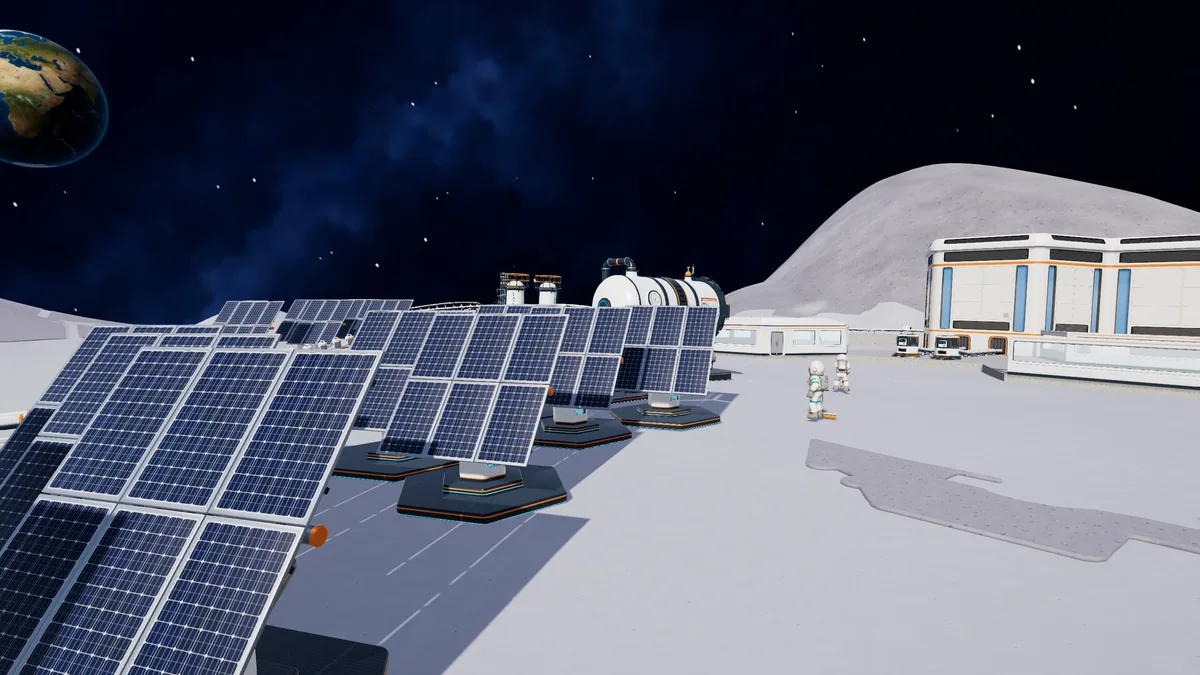
The large solar tracker follows the Sun and stores spare power in a 10 kWh battery. Fixed panels point in one direction and charge a smaller battery. The Solar Post (S) has no battery at all.
Panels
Compare the three solar panels
| Panel | Price | Full-sun output | Battery | Range | Facing |
|---|---|---|---|---|---|
| Solar Post (S) | $75 | 3 kW | None | 16 m | Fixed; face the Sun |
| Solar Twin (M) | $150 | 7.5 kW | 4 kWh | 24 m | Fixed; face the Sun |
| Solar Tracker (L) | $300 | 16 kW | 10 kWh | 34 m | Turns to follow the Sun |
Spare power charges a tracker battery at 92% efficiency. The machine stops below 8% of its required power.
The large tracker is usually the right choice because it combines the highest output, the largest battery and the longest range. A small post can be useful for a temporary daylight-only pump or a tiny load, but it cannot carry a machine through the night on its own.
Sizing
Size the array with the night load
| Machine | Power | 30-minute night energy | Minimum panel plan |
|---|---|---|---|
| Pressure chamber | 10 kW | 5 kWh | 2 large trackers for margin (20 kWh total battery) |
| Stone press | 18 kW | 9 kWh | 3 large trackers for margin (30 kWh total battery) |
| Both machines | 28 kW | 14 kWh | 3–4 large trackers; stagger loads if the battery falls |
| Packager | 0 kW | 0 kWh | No power needed |
The 30-minute night estimate uses the machine's rated draw. The creator field rule — two large panels per pressure chamber, three per stone press — leaves extra margin for charging losses and other loads.
A machine may run at part power and still be below its full cycle rate. The simple table is a sizing check, not a promise that every machine runs nonstop. If the battery empties, reduce the number of active machines rather than buying another panel you cannot place.
Night vision
Night Vision Goggles solve visibility, not power
Patch 1.0.4 added Night Vision Goggles for $350. Press N to cycle between the helmet lamp, goggles and off. The goggles make night look like daytime without shadows, but they do not generate or store energy. A dark factory can have full batteries and still look dark if the lights are off.
Vehicle floodlights are a separate upgrade. They help a driver see, not a pressure chamber run.
Diagnosis
Diagnose a night-time stoppage
- Check the machine's power indicator. It stops below 8% of its requirement.
- Check the battery state and the time of day. A tracker with 0 kWh cannot carry a 10 kW load through the night.
- Check that the machine is within the panel's range: 16 m for a small post, 24 m for a twin, 34 m for a tracker.
- If the panels are fixed, check their facing and the Sun's position.
- Remove nonessential loads or stagger machine starts; a single battery can be drained by several machines at once.
- If the line is powered but does not move, check the input and output before adding another panel.
Straight answers
Questions about this task
How many solar panels do I need at night?
The field rule is two large trackers per pressure chamber and three per stone press. The arithmetic is 10 kW / 5 kWh for a pressure chamber and 18 kW / 9 kWh for a stone press over a 30-minute night; the extra tracker is margin.
How much battery does one large panel have?
A Solar Tracker (L) has a 10 kWh battery and produces 16 kW in full sun. It reaches machines within 34 m.
Is there another power source besides solar?
The checked 1.0.4 data lists only the three solar panels. This guide cannot claim solar is the game's only power source, but no other generator was found in the inspected material.
Trace the answer
Sources and scope
This is an independent, source-led guide, not a first-hand playtest. Gameplay values, build-menu details and UI behavior are checked against the 1.0.4 data snapshot and official patch notes. Your installed build is the final authority.
- Reference Wikily: Day and night Moon Sweepers 1.0.4 data index, checked 28 Oct 2026. Useful for build-menu values; not an official developer page.
- Reference Wikily: Solar tracker Moon Sweepers 1.0.4 data index, checked 28 Oct 2026. Useful for build-menu values; not an official developer page.
- Reference Wikily: Solar twin Moon Sweepers 1.0.4 data index, checked 28 Oct 2026. Useful for build-menu values; not an official developer page.
- Reference Wikily: Solar post Moon Sweepers 1.0.4 data index, checked 28 Oct 2026. Useful for build-menu values; not an official developer page.
- Reference Wikily: Pressure chamber Moon Sweepers 1.0.4 data index, checked 28 Oct 2026. Useful for build-menu values; not an official developer page.
- Reference Wikily: Stone press Moon Sweepers 1.0.4 data index, checked 28 Oct 2026. Useful for build-menu values; not an official developer page.
- Official Moon Sweepers 1.0.4 patch notes Official patch notes, 25 Oct 2026.